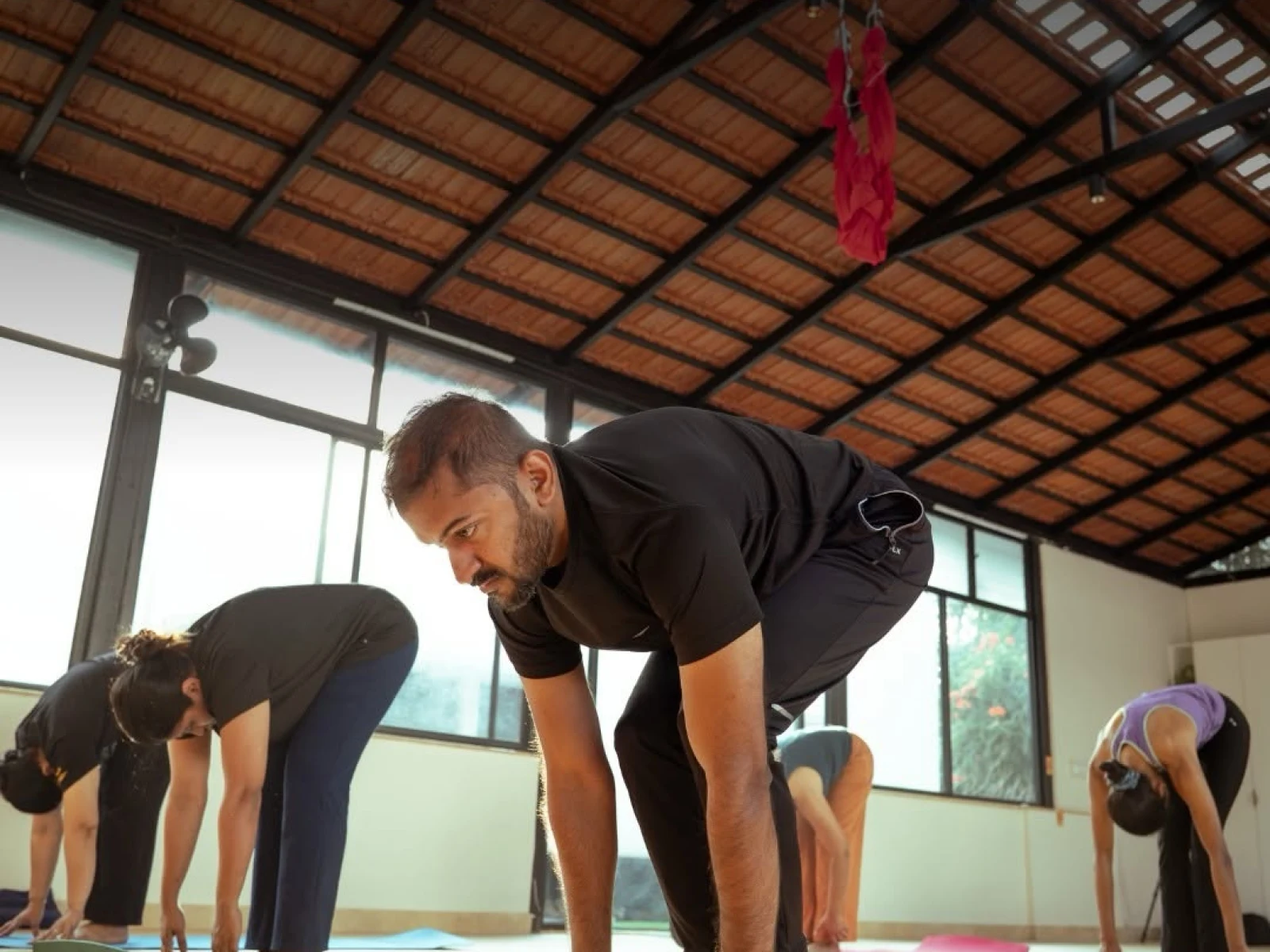
Desk Yoga for Office Workers: Movement Breaks for People Who Sit All Day
Key Takeaways
- This article covers actionable guidance from Absolute Yoga's certified instructors.
- Topics include yoga practice, breathwork (pranayama), flexibility, mindfulness, and stress relief.
- Suitable for beginners and regular practitioners seeking structured yoga in Bangalore.
- Absolute Yoga offers in-studio, online, and aerial yoga classes from HRBR Layout, Kalyan Nagar.
A desk-based workday can make movement feel optional. You sit down to answer one email, then move into a meeting, finish a report and look up several hours later. By the end of the day, your shoulders may feel tight, your hips may feel stiff and you may have little energy left for a full workout. Desk yoga offers a practical starting point: short, gentle movement breaks that fit around work without pretending to replace a complete yoga class or a wider physical-activity routine.
What is desk yoga and how does it fit into an office routine?
Desk yoga is a convenient label for gentle yoga-inspired movement, mobility and breathing-awareness practices that can be adapted to a workstation. Some movements can be done seated; others require standing beside the desk or taking a short walk. The purpose is to interrupt long periods in one position and help you notice how your body feels. It is not about performing advanced postures in office clothes or forcing a stretch to match a photograph.
Why desk-based workers need movement breaks
Sitting is a normal part of many jobs, but long uninterrupted periods of sedentary behaviour are worth breaking up. The World Health Organization recommends limiting sedentary time and replacing it with physical activity of any intensity. Its guidance also recognises that doing some activity is better than doing none. A short walk, standing break or gentle mobility sequence can be an achievable first step during a busy workday.
Desk yoga should not be presented as a treatment for back pain, neck pain or a medical condition. Persistent, worsening or unexplained symptoms need appropriate healthcare assessment. The aim here is to offer general movement ideas for otherwise healthy adults and encourage a more varied workday.
Desk yoga: five gentle movements to try at work
1. Seated shoulder rolls
Sit with your feet supported and allow your arms to rest comfortably. Slowly lift your shoulders, move them backwards and lower them without forcing the range. Repeat several times, then reverse the direction. Keep your jaw relaxed and avoid turning the movement into a fast shrug. This is an easy desk yoga option after a long typing session or before moving into another task.
2. Comfortable seated spinal movement
Sit towards the front of a stable chair with both feet grounded. Gently lengthen through the crown of your head and allow your chest to lift slightly. Return to a neutral position on the exhale. Keep the movement small and comfortable; do not force a deep backbend or collapse the lower back. The goal is to change position and bring attention back to your posture.
3. Standing side reach
Stand with feet comfortably apart and keep your balance. If your shoulders allow it, raise one arm and lean gently to the opposite side. Avoid twisting, bouncing or leaning against unstable furniture. Return to the centre and change sides. Skip the raised-arm version if it causes shoulder discomfort.
4. Hand and wrist mobility
Open and close your fingers slowly, then make gentle wrist circles within a comfortable range. Avoid pulling hard on your fingers or pushing the wrist into an extreme position. This is a short movement pause, not a rehabilitation programme for repetitive-strain symptoms. If you have persistent hand or wrist pain, ask a clinician for individual advice.
5. Stand, walk and reset your focus
Stand up from your chair, look away from the screen and walk briefly if the space allows. Let your arms move naturally and take a few comfortable breaths. You do not need to turn every break into a formal exercise session. Changing position is often the simplest way to interrupt a long stretch of sitting.
How often should you take desk yoga breaks?
There is no single interval that suits every worker. A practical approach is to connect movement to existing events: after a meeting, when you finish a task, before lunch or when you refill your water. If you often lose track of time, use a calendar reminder or a break timer. Start with one or two realistic pauses and add more only when the habit feels manageable.
| Workday moment | Possible movement break | Why it is practical |
| Before opening your laptop | Stand comfortably and take a few natural breaths | Creates a deliberate start to the day |
| After a meeting | Shoulder rolls or a short walk | Separates one long sitting period from the next |
| Mid-morning | Stand and move away from the screen | Changes posture and visual focus |
| Before lunch | Gentle seated spinal movement | Can be done in a small space |
| Mid-afternoon | Walk briefly or do a comfortable side reach | Adds a movement pause during a common low-energy period |
| After work | Take a walk or attend a guided class | Moves beyond brief desk breaks |
Desk yoga is not a substitute for a complete yoga class
A few chair-based movements can make a workday less static, but they do not provide the same learning experience as a structured class. A guided yoga session may include warm-up, posture practice, alignment cues, modifications, breathing and relaxation. It can also help you learn which movements suit your body and how to progress safely. If you want to move beyond short breaks, explore in-studio yoga classes in Bangalore or live online yoga classes in India.
Desk yoga for neck, shoulder and back discomfort: what to know
It is tempting to assume that every discomfort experienced at a desk is caused by posture and can be fixed with a stretch. That is too simplistic. Discomfort can have several causes, and a movement that feels comfortable for one person may not suit another. Avoid forcing end-range stretches, twisting sharply or copying advanced movements from social media. Stop if a movement causes pain, dizziness, numbness, tingling or unusual symptoms.
For general information about yoga safety, the National Center for Complementary and Integrative Health explains that yoga is generally considered safe for healthy people when performed properly, while noting that injuries can occur and some people may need modifications. If you have ongoing back symptoms, read the existing yoga for lower back pain guide as general information, not as a diagnosis or treatment plan.
Breathing awareness during a busy workday
A short pause can include noticing your natural breathing. Sit or stand comfortably and observe the breath without trying to make it unusually deep, slow or controlled. If breath-focused attention feels uncomfortable, simply look away from the screen or take a brief walk. Structured breathing techniques are different from ordinary breathing awareness and are best learned with appropriate instruction. Absolute Yoga has an educational article about pranayama classes and breathing practices in Bangalore for readers who want to understand that subject in more detail.
Build a desk yoga habit that survives a busy week
The most common mistake is designing an ideal routine that does not fit the real workday. Keep the first version small. Choose two triggers, such as after the first meeting and before lunch. Decide in advance which movement you will do. Keep the movements simple enough to perform safely in your workspace. If your schedule changes, move the break rather than abandoning it altogether.
People managers and organisations can also make movement easier by allowing short breaks, encouraging walking meetings where practical and providing space for guided sessions. For a more structured workplace offering, explore the corporate yoga classes in Bangalore guide.
When should you move from desk yoga to guided practice?
If your aim is to develop a more complete routine, learn alignment or explore a wider range of yoga practices, a guided class is a sensible next step. You can choose a studio session if you value face-to-face instruction or a live online class if travel is a barrier. Read the online yoga versus in-studio comparison to understand the practical differences. Absolute Yoga offers both formats; confirm the current schedule, suitability and booking process before attending.
Frequently asked questions
1. What is desk yoga?
Desk yoga is a set of gentle yoga-inspired movements and breathing-awareness pauses adapted for an office or home workstation.
2. Can I do desk yoga without a yoga mat?
Yes. Many simple movements can be performed seated or standing. Use a stable chair, clear space and movements that do not require equipment.
3. How long should a desk yoga break last?
There is no universal duration. Start with a short, practical pause and repeat it at moments that fit your workday.
4. Is desk yoga suitable for beginners?
Gentle options may suit many beginners, but people with injuries, medical conditions or movement limitations should seek individual guidance.
5. Can desk yoga replace a regular yoga class?
No. Desk yoga is a supplement to daily movement. It does not replace a structured class or broader physical activity.
6. Can I practise desk yoga in an office?
Usually, if your workplace permits it and you have enough room. Choose discreet movements and avoid anything that affects your balance or nearby colleagues.
7. Does desk yoga cure back or neck pain?
No. It should not be presented as a cure. Persistent or worsening symptoms need assessment by an appropriate healthcare professional.
8. How often should I take movement breaks?
There is no one-size-fits-all schedule. Link breaks to meetings, task changes or other predictable moments, and avoid remaining in one position for unnecessarily long periods.
9. Can I learn yoga online if I work long hours?
Live online classes can reduce travel time and provide instructor guidance. Check the schedule, format and whether the class suits your experience and needs.
10. Does Absolute Yoga offer classes for people with desk-based routines?
Absolute Yoga lists in-studio and live online yoga classes. Contact the studio to discuss your schedule and confirm which current class may suit you.
Make movement part of the working day
Desk yoga is not about adding another demanding task to your calendar. It is about making movement easier to remember and easier to repeat. Start with a short walk, a comfortable change of position or a gentle mobility break. If you want to develop a fuller practice, explore Absolute Yogaâs in-studio classes or its live online yoga options.
External reference: WHO â Physical Activity
External reference: NCCIH â Yoga: Effectiveness and Safety