Aerial Yoga in Bangalore: Beginner Guide to Safety, Fees and Your First Class
Key Takeaways
- This article covers actionable guidance from Absolute Yoga's certified instructors.
- Topics include yoga practice, breathwork (pranayama), flexibility, mindfulness, and stress relief.
- Suitable for beginners and regular practitioners seeking structured yoga in Bangalore.
- Absolute Yoga offers in-studio, online, and aerial yoga classes from HRBR Layout, Kalyan Nagar.
Quick answer
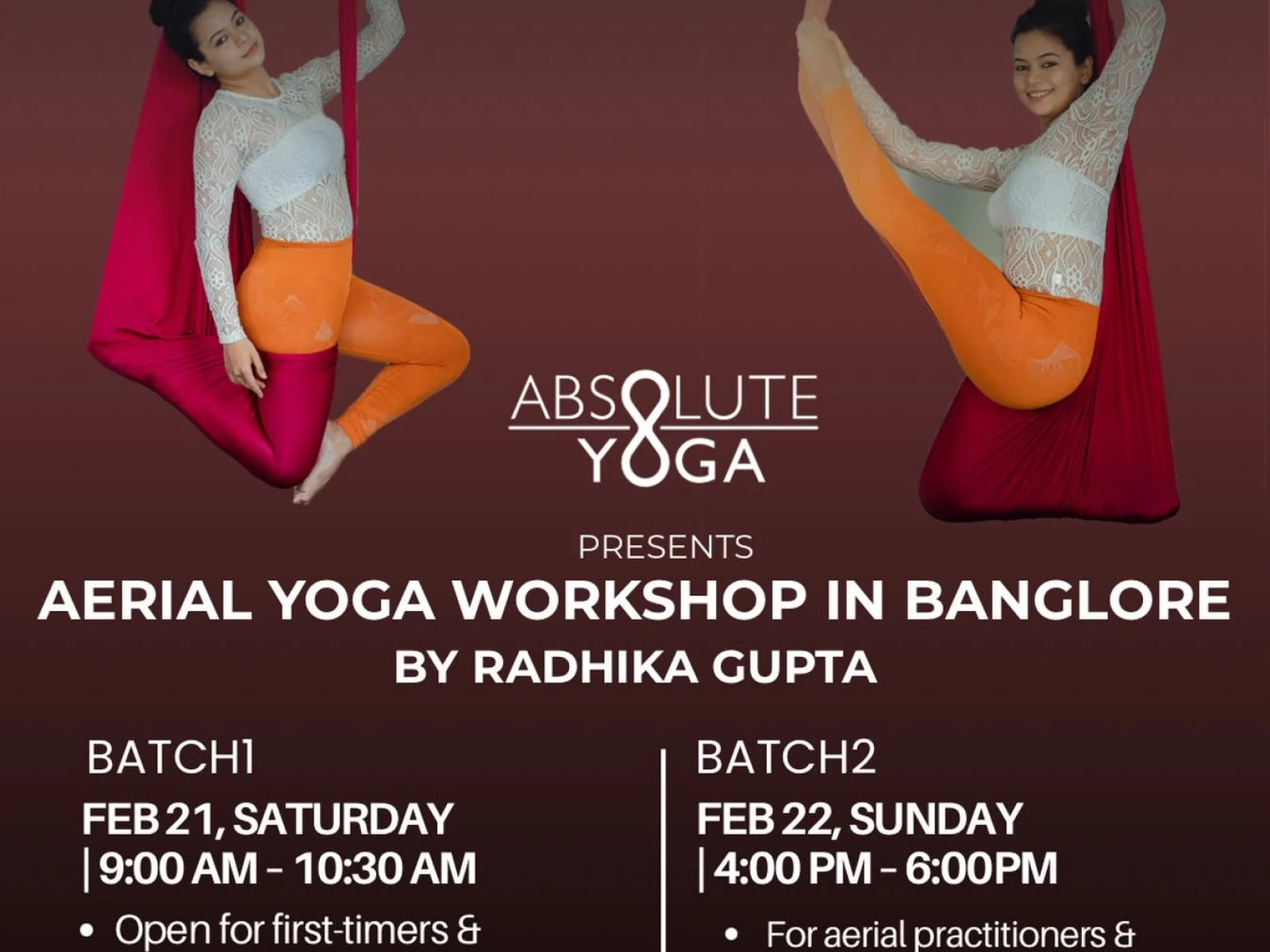
Aerial yoga looks different from a conventional mat class. A fabric hammock supports parts of the body during selected movements, and the practice may include standing work, supported stretches, balance, gentle inversions or relaxation. If you are searching for aerial yoga near me in Bangalore, the pictures may be what caught your attention. Before booking, understand what the class involves, what it does not promise, how a beginner session should be taught, and what to ask about equipment and safety.
What aerial yoga actually is
Aerial yoga uses a suspended fabric hammock as a prop. Depending on the class, the fabric may support the hips, back or legs, assist selected stretches, or create a different relationship with balance and body awareness. It is not simply acrobatics, and a beginner class should not require advanced inversions. The hammock changes how a movement feels, but it does not remove the need for instruction. Students still need to learn where to place the fabric, how to enter and leave positions, and when to reduce the range of movement. Different studios use different formats, so ask what the class includes rather than assuming every aerial class has the same sequence, intensity or level of inversion.
Who might enjoy an aerial class?
Aerial yoga may appeal to people who enjoy trying a new movement format, want a change from mat-based practice, or are curious about supported stretches and balance. Some people enjoy the sensory experience of the hammock; others need time to become comfortable with the fabric and height. You do not need to be an advanced yoga practitioner to enquire about a beginner class. Choose a class that introduces equipment gradually and gives you time to learn the basics. Flexibility should not be treated as an entry requirement, and you should not feel pressured to copy an experienced student. Comfort with height, ability to get in and out of the hammock, balance, medical history and class design all matter.
What happens in a first aerial yoga class?
A first session should begin with an orientation to the hammock and studio rules. The teacher should explain how to approach the fabric, where to position the body, how to hold the hammock and how to exit a movement. The warm-up may include standing movements, shoulder and hip mobility, or supported positions close to the floor. The instructor may introduce a small number of hammock-supported shapes. Ask whether the class is beginner or mixed-level. Expect to spend time learning the equipment rather than performing a long series of impressive poses. A useful first class gives you repetition to understand basic movements and options to stop, rest or choose a simpler variation. You should never be rushed into an inversion to keep up.
Equipment and safety questions to ask
Ask how the hammock and suspension points are installed, inspected and maintained, and what use rules apply. The instructor should explain the studioâs safety process in straightforward terms. Check whether the studio provides an equipment briefing, explains how to enter and exit positions, and supervises students during unfamiliar movements. Ask how class size affects supervision and whether the teacher can help individuals when needed. If inversions are included, ask what prerequisites or alternatives are used. Do not treat the absence of pain as proof that a position is appropriate. Stop and tell the instructor if you feel dizzy, nauseated, panicked or physically unsafe. A responsible class makes modifying or stopping an acceptable choice.
Health considerations before booking
Aerial yoga can involve pressure from fabric, changes in body position, balance demands and inversions. If you are pregnant, have glaucoma, uncontrolled blood pressure, vertigo, significant neck or back concerns, recent surgery, a hernia or another condition that could be affected by inversion or pressure, seek advice from an appropriate healthcare professional and discuss your situation with the instructor before participating. This is not a diagnosis or a complete screening list. Only a qualified healthcare professional who understands your circumstances can advise on your individual risk. NCCIH explains that yoga is generally considered safe for healthy people when practised properly under qualified guidance, but injuries can occur and some people need modified practices. Read NCCIH yoga evidence and safety guidance. Aerial yoga has additional equipment and position-specific considerations, so ask the studio about its procedures.
What should you wear and bring?
Choose comfortable clothing that covers areas likely to contact the fabric. Avoid zips, sharp jewellery, watches or accessories that could snag or damage the hammock. Follow the instructorâs rules about footwear and grip. Ask whether the studio provides the hammock and any other props. Check the specific clothing rules before travelling because different equipment and studio practices may lead to different recommendations. Arrive early enough to complete the introduction without rushing. Tell the instructor that this is your first aerial session and mention movements that make you nervous. You do not need to prove confidence. Honest communication helps the teacher suggest an appropriate starting point.
How to compare aerial yoga fees in Bangalore
Do not compare only the headline price. Check class duration, whether it is a dedicated aerial session or part of a broader membership, how many sessions are included, whether booking is required and what happens if you miss a class. Aerial sessions may be priced differently from general yoga because of equipment, space and class-size considerations. Ask whether a trial is available and whether it includes the same format you intend to purchase. Confirm the current timetable, exact location, cancellation rules and whether the membership allows you to switch between aerial and other classes. Absolute Yoga publishes information at Absolute Yoga aerial yoga page and a guide at aerial yoga guide. Confirm current prices and availability directly.
How to decide whether aerial yoga is right for you
After a trial, consider how the teacher explained the equipment, whether the pace felt manageable, whether the hammock was comfortable and whether you felt free to ask for help. Enjoyment matters, but clear instruction and safe progressions matter too. You do not have to enjoy every class style. If the hammock feels uncomfortable or the class is not a good fit, mat-based Hatha yoga or a gentler class may suit you better. The purpose of trying aerial yoga is to learn whether it works for you, not to force yourself to like it. If you are new to yoga altogether, read beginner first-class guide or compare Hatha and Ashtanga at Hatha versus Ashtanga yoga guide.
What to look for in an instructor
An instructor should explain equipment, demonstrate movements clearly, provide progressions and alternatives, and avoid pressuring students into advanced shapes. They should answer questions about training and experience with aerial practice. Ask whether beginners are grouped separately or included in mixed-level sessions. Credentials can be one useful signal, but aerial teaching also requires competence with the specific equipment and class format. For information about yoga teaching credentials in the wider profession, review Yoga Alliance. Do not assume that a general credential alone proves expertise with every aerial apparatus. Notice how the instructor responds when someone needs a break or asks to modify a movement. Respect for student boundaries is part of a quality learning environment.
A simple first-class plan
Before booking, confirm the class level, time, fee, location, clothing rules, equipment briefing and health-screening requirements. Tell the studio that you are new. Arrive early and listen to the safety instructions before touching or adjusting equipment. During class, move at the pace the instructor sets, ask before trying an unfamiliar variation, and choose a supported option if a movement feels too intense. Do not attempt inversions or tricks seen online outside the instruction provided in class. After class, note what you enjoyed and what you would like explained further. Ask which class the teacher recommends next and whether that step is appropriate for a beginner. A good first experience leaves you curious and informed, not pressured to progress faster than you are ready for.
Understand the difference between challenge and risk
A new movement can feel unfamiliar without being unsafe, but excitement should not override sensible limits. In aerial yoga, the hammock changes leverage and support, so a position that looks simple in a photograph may feel very different when you try it. Ask for a demonstration and wait until the instructor has explained the entry and exit. Do not improvise a transition because another student appears comfortable. Avoid treating social media videos as a training plan: short clips rarely show preparation, supervision, equipment setup or the steps used to learn a movement. If you are uncertain, stay with a supported version or observe. You are allowed to decline a pose. A teacher should explain the purpose of a movement and help you choose a suitable option, not frame every challenge as something you must overcome.
How to prepare mentally for the hammock
Some beginners feel excited; others feel nervous about height, balance or being watched. Both reactions are normal. Tell the instructor which part feels unfamiliar and ask whether the class can begin with low, supported movements. You can take a break, watch a demonstration or skip a movement while you become comfortable with the equipment. Avoid comparing your experience with a more confident student. Their familiarity may come from previous classes or other movement training. It is reasonable to need several sessions to understand the fabric and transitions. If you experience panic, dizziness or discomfort, communicate clearly and exit the position with the instructorâs help. The goal is not to eliminate every nervous feeling, but to learn in an environment where you can make thoughtful choices.
What a studio should explain before payment
Before purchasing a package, ask whether the class is dedicated to aerial yoga, whether sessions must be reserved, how cancellations work, and whether a missed class can be rescheduled. Confirm whether a trial is the same length and format as a regular session. Ask if there are age, health or experience requirements and what the instructor needs to know before class. You should also understand the total cost, expiry date, refund or transfer rules, and whether the package includes other yoga styles. Get important terms in writing rather than relying on a verbal summary. A clear answer does not guarantee that a studio is right for you, but unclear answers make it harder to make an informed decision. Compare the full experience, not just the first-session offer.
Frequently asked questions
Is aerial yoga suitable for complete beginners?
It can be, if the studio offers a beginner-appropriate class with equipment orientation and gradual progressions. Confirm the level before booking.
Do I need to be flexible?
No specific level of flexibility should be assumed. Choose a class that offers options and avoid forcing a position to match another student.
Is aerial yoga safe?
Safety depends on equipment, installation and maintenance, instructor competence, class design and individual health considerations. Ask about procedures and disclose relevant concerns.
Can aerial yoga involve inversions?
Some classes include inversions while others focus on supported movements. Ask what the class includes and never attempt an unfamiliar inversion without instruction.
What should I wear?
Wear comfortable clothing that covers areas in contact with the fabric. Avoid jewellery, zips and accessories that could snag the hammock.
Can I do aerial yoga with a neck or back problem?
Ask an appropriate healthcare professional and discuss your situation with the instructor before participating.
How much does aerial yoga cost in Bangalore?
Prices vary by studio, duration, membership and number of sessions. Confirm current rates and cancellation terms directly.
How is aerial yoga different from regular yoga?
Aerial yoga uses a suspended hammock to support or change selected movements. Mat-based yoga does not use that apparatus.
What should I ask before my first class?
Ask whether it is beginner-friendly, what movements are included, how equipment is checked, what to wear and how students are supervised.
How do I check current aerial yoga timings at Absolute Yoga?
Visit the official aerial yoga page or contact Absolute Yoga to confirm the current schedule, availability, fees and trial options.
External references
NCCIH, Yoga: Effectiveness and Safety: NCCIH yoga evidence and safety guidance
Approximate article plus FAQ word count: 1619.