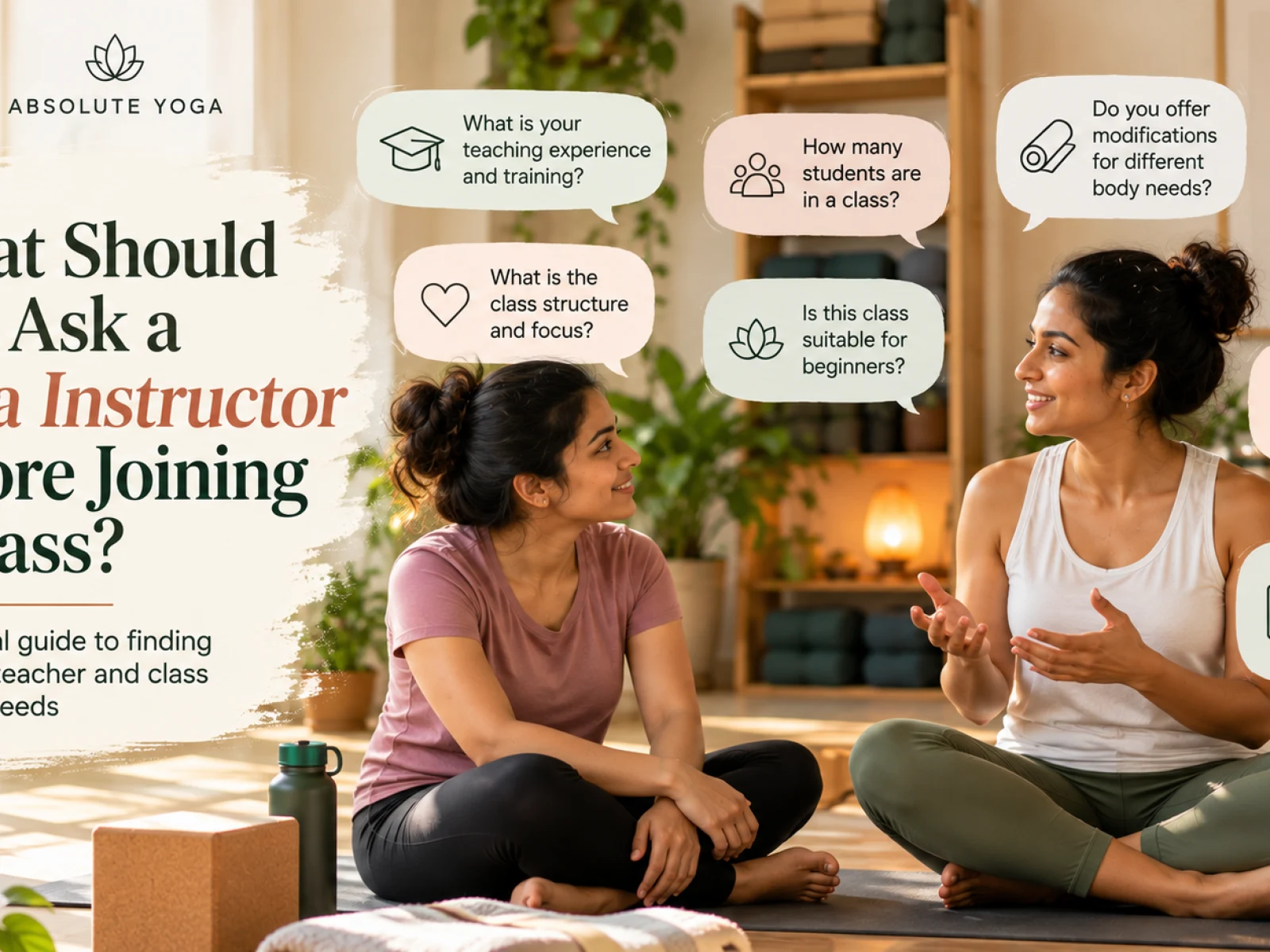
What Should You Ask a Yoga Instructor Before Joining a Class?
Key Takeaways
- This article covers actionable guidance from Absolute Yoga's certified instructors.
- Topics include yoga practice, breathwork (pranayama), flexibility, mindfulness, and stress relief.
- Suitable for beginners and regular practitioners seeking structured yoga in Bangalore.
- Absolute Yoga offers in-studio, online, and aerial yoga classes from HRBR Layout, Kalyan Nagar.
What Should You Ask a Yoga Instructor Before Joining a Class?
Choosing a yoga class is not only about the studioâs location, price or photographs. The instructor and the way a class is taught can shape whether you feel supported, challenged appropriately and able to keep practising. Asking a few clear questions before joining helps you understand what to expect and whether the class fits your needs.
You do not need to interrogate a teacher or arrive with technical knowledge. A good conversation can be simple: what does the class involve, who is it suitable for, how are modifications offered, and what should you know before your first session? The aim is not to find a perfect-sounding answer. It is to make an informed decision and feel comfortable raising practical concerns.
Use the questions below as a checklist. Some are especially important for beginners; others matter if you have an injury, prefer a particular style or need a schedule you can maintain.
1. What Style and Level Is This Class?
Ask what the class generally includes and how demanding it is likely to feel. Labels such as Hatha, flow, restorative or beginner-friendly can mean different things across studios and instructors. Ask the teacher to describe the pace, movement, breathing practices and whether the session includes time for rest.
If you are new, ask whether the instructor assumes prior experience or explains foundational movements. A class can include students at different stages, but you should know how the teacher supports people who need a simpler option. Do not choose a class solely because its name sounds familiar or impressive.
Useful follow-up: âIf I have never attended yoga before, what should I expect in the first two or three sessions?â This invites a practical answer rather than a general promise that everyone can do everything.
2. How Do You Support Different Bodies and Experience Levels?
People differ in strength, mobility, balance, confidence and learning style. Ask how the teacher offers modifications when a pose feels too difficult or does not suit a studentâs body. You might also ask whether props or alternatives are available and whether it is acceptable to rest during class.
Pay attention to the tone of the answer. You should feel able to ask for help without being shamed or pressured to match another student. A teacher does not need to promise that every posture will be suitable for everyone; a thoughtful answer recognises individual differences and explains how options are handled.
If flexibility is a concern, read our guide on your first yoga class in Bangalore. You do not need to be flexible before beginning, but you do need a class that helps you practise at an appropriate level.
3. What Training and Experience Do You Have?
Ask about the instructorâs training, experience teaching people at your level and any specialist experience relevant to your goals. A useful answer should make it clear what the teacher is trained to teach and when they would recommend another professional. Do not assume that a large social following or difficult personal practice automatically means someone is suited to teach beginners.
Credentials vary by training pathway and region. If an instructor refers to a certification, ask what the programme covered and how they continue learning. Organisations such as Yoga Alliance provide information about their own standards and credentials, but a registry entry is not a guarantee of teaching quality or a substitute for evaluating the actual class.
Also ask who will teach the sessions you plan to attend. A studio may have multiple instructors with different approaches. If consistency matters to you, understanding the regular teacher and how substitutions are handled can help you decide.
4. What Should I Tell You About My Health or Limitations?
Before class, share relevant information that could affect practice, such as a current injury, movement limitation, balance concern, pregnancy-related consideration or medical advice you have been given. You do not need to disclose unrelated personal details. The point is to give the teacher enough information to discuss suitable modifications and whether the class is appropriate.
Ask how the instructor prefers students to communicate discomfort during class. You should feel able to stop, rest or ask for an alternative. A teacher can guide yoga practice but does not diagnose medical conditions or replace a clinician. If you have a health concern, follow advice from a qualified healthcare professional and ask whether the class can accommodate any restrictions.
The NCCIH overview of yoga and safety discusses potential benefits and safety considerations. It is useful background, but personal medical questions should be addressed with your healthcare provider.
5. How Large Is the Class, and Will I Get Guidance?
Ask about the usual class size and how the teacher gives feedback. Some people learn well in a larger group; others prefer a smaller setting where questions are easier. There is no single ideal number for every class, but the instructor should be able to explain how they manage attention, demonstrations and corrections.
Ask whether verbal cues and demonstrations are provided, and how a student can signal that they need help. If physical adjustments are used, you can ask how consent is handled and say what you are comfortable with. You are entitled to communicate boundaries and ask for a verbal alternative.
Use the first session to observe whether the teacher notices when students are struggling and whether instructions are clear. A class description can tell you what is intended; your experience tells you how the teaching feels in practice.
6. What Is the Schedule, Attendance Policy and Total Cost?
Consistency often depends on logistics more than inspiration. Ask for the current timetable, session duration, booking process, membership validity, make-up rules, cancellation policy and any additional charges. If you travel to the studio, check the real start time and how early you should arrive.
Ask what happens if work or family responsibilities interrupt your schedule. Avoid choosing a plan based only on the lowest monthly equivalent if its validity or attendance rules do not match your life. A realistic plan is one you can use without constant pressure to recover missed classes.
For current local options, review the details for in-studio yoga classes and confirm all fees and policies directly before purchasing. Timetables and terms can change, so treat the current booking information as authoritative.
7. What Should I Bring, Wear or Prepare?
Ask whether you need your own mat, whether props are supplied, what clothing is comfortable and whether there are any arrival instructions. You may also want to know whether there is a place to store belongings or whether you should avoid a heavy meal immediately before class. The studio can give practical guidance based on its space and class format.
Do not buy specialised equipment before you know what is needed. Comfortable clothing and the ability to move are usually more important than matching a particular look. If the class involves a specialised format, ask about any additional preparation or restrictions.
These small details reduce uncertainty and make the first visit less stressful. They also reveal whether the studio communicates clearly before you arrive.
8. How Will We Know Whether This Class Is a Good Fit?
Ask what a new student should pay attention to after the first few sessions. The answer should not promise dramatic results in a fixed number of days. Better indicators may include understanding instructions, feeling comfortable asking questions, finding suitable modifications and being able to attend without unreasonable stress.
Give yourself permission to evaluate the class. Do you feel respected? Is the pace appropriate? Are explanations clear? Does the instructor respond thoughtfully to questions? Is the commute and schedule sustainable? You can appreciate a teacher and still decide that a different class suits you better.
Our guide to choosing a yoga studio near you in Bangalore covers broader studio-selection factors. This checklist is the conversation to have with the instructor once you have a potential class in mind.
A Short Message You Can Send Before Booking
You can keep your first enquiry simple. For example: âHello, I am considering joining a yoga class. I am a beginner and would like to understand the style, class level, current timings and what I should bring. Could you also let me know how modifications are offered if a pose feels difficult?â
If you have a relevant limitation, add a brief sentence and ask whether the teacher recommends any precautions before attending. Do not rely on a message to receive a medical assessment; use it to establish whether the class may be appropriate and what the next step should be.
If you are considering Absolute Yoga, you can check the current details for yoga classes in HRBR Layout or ask about live online yoga classes, depending on your preferred format. Confirm schedules and availability directly.
The Questions Matter, but So Does the Experience
Questions help you make an informed choice, but they cannot tell you everything. Notice how the instructor communicates, whether you can ask for help, and whether the class feels appropriately paced once you attend. You do not need to make a long-term commitment before you understand the teaching environment and terms.
Choose a teacher who takes questions seriously, explains options clearly and respects your boundaries. The right class should support learning rather than require you to ignore discomfort or prove your ability. A thoughtful first conversation is a practical beginning to a safe, sustainable yoga practice.
Frequently Asked Questions
What is the most important question to ask a yoga instructor?
Ask whether the class is suitable for your experience and how the teacher offers modifications when a pose is too difficult or unsuitable.
Should I ask about a yoga teacherâs qualifications?
Yes. Ask about relevant training and experience teaching people at your level, especially if you have specific needs.
Should I tell the instructor about an injury?
Share relevant information that could affect practice and follow advice from your healthcare professional. The instructor can discuss yoga modifications but cannot diagnose the injury.
How do I know if a yoga class is beginner-friendly?
Ask what the class includes, whether foundational movements are explained and how students can request easier options or rest.
Is it okay to ask not to receive physical adjustments?
Yes. Communicate your boundaries and ask for verbal cues or demonstrations instead.
What should I ask about fees before joining?
Confirm the total cost, validity period, attendance limits, booking rules, cancellations, make-up classes and any additional charges.
Should I attend a trial class before committing?
If the studio offers one, it can help you assess teaching style, pace, logistics and comfort. Confirm current availability and terms directly.
How many students should be in a yoga class?
There is no universal ideal. Ask how the instructor manages guidance and questions for the usual class size.
What if I feel uncomfortable during class?
Stop or rest if needed, communicate with the teacher and do not force a movement. If the environment does not respect your boundaries, reconsider whether it is a good fit.
Can I ask the instructor for a different class?
Yes. Ask which current class may better match your goals, experience, schedule or physical needs.