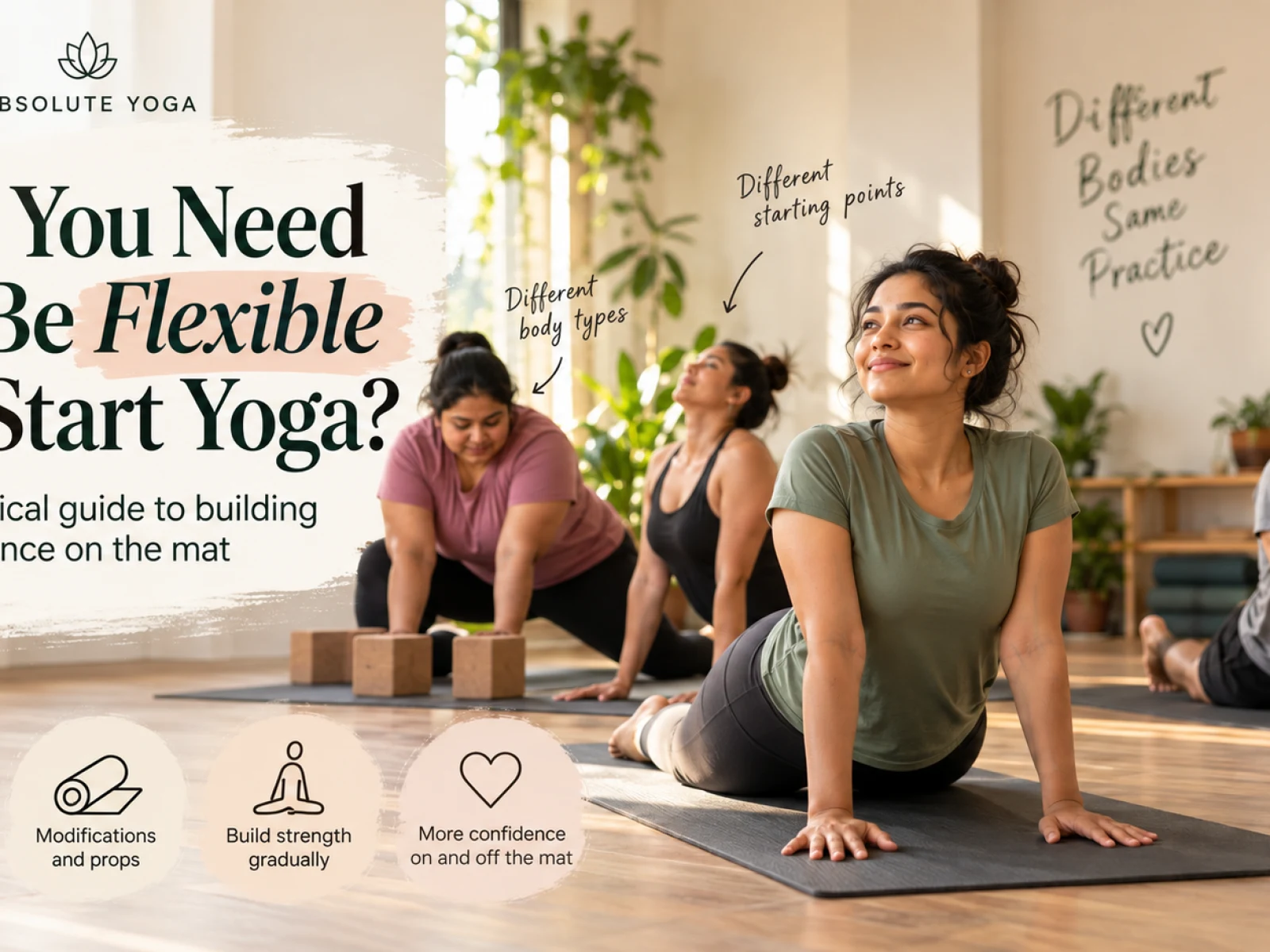
Do You Need to Be Flexible to Start Yoga? What Beginners Should Know
Key Takeaways
- This article covers actionable guidance from Absolute Yoga's certified instructors.
- Topics include yoga practice, breathwork (pranayama), flexibility, mindfulness, and stress relief.
- Suitable for beginners and regular practitioners seeking structured yoga in Bangalore.
- Absolute Yoga offers in-studio, online, and aerial yoga classes from HRBR Layout, Kalyan Nagar.
Do You Need to Be Flexible to Start Yoga?
No. You do not need to touch your toes, sit comfortably in a split or match the range of motion you see in a class photo before you begin yoga. Flexibility is not an entry requirement. A suitable class should help you explore movement from your current starting point, with modifications when needed.
Many people delay starting because they think yoga is only for naturally flexible people. That belief reverses the purpose of practice. You come to learn, not to prove you already have the ability. Flexibility is only one part of yoga, alongside balance, strength, coordination, breathing, attention and learning how to respond to your own limits.
That does not mean every pose or class is appropriate for every body. The goal is not to force a range of motion. It is to practise within a suitable range, receive clear instruction and progress gradually. If you have an injury or medical condition, ask for guidance about what should be modified.
What Flexibility Actually Means
Flexibility generally refers to how far a joint or group of joints can move, influenced by factors such as anatomy, tissue properties, temperature, activity, age and individual variation. It is not a single score that determines whether you can participate in yoga. Different people naturally have different ranges, and those ranges do not need to look identical.
Mobility and flexibility are related but not interchangeable. Mobility often refers to the ability to move a joint through a range with control. A posture that looks deep is not automatically better than a smaller movement that you can control comfortably. Yoga can involve learning to move, stabilise, breathe and pay attention, rather than simply stretching farther.
Your body may feel different from one day to the next. Sleep, stress, activity, temperature and how long you have been sitting can affect how movement feels. Do not treat a stiff day as evidence that you are failing. Adjust the practice to the body you have that day.
Why Comparing Yourself With Other Students Can Mislead You
In a group class, two people may follow the same instruction but look very different. One may have more experience, a different body structure or a different history of movement. Another may choose a modification because it helps them maintain control. The appearance of a pose alone does not tell you how well someone is practising.
Trying to copy the deepest version of a posture can encourage you to push beyond your current range. It may also distract you from the instructorâs cues about breathing, alignment and where to place your attention. A useful question is not âCan I make my pose look like theirs?â but âCan I do this variation with control and without forcing?â
Social media can intensify the comparison because images often highlight extreme shapes, carefully selected angles and experienced practitioners. They rarely show the modifications, rest or gradual learning that make a practice sustainable. Use images for inspiration if helpful, but do not use them as a standard for what your body should do.
How to Begin If You Feel Stiff
Start by telling the instructor that you are new and that flexibility is a concern. Ask whether the class is appropriate for beginners and how modifications are offered. A well-guided session should make it possible to ask questions, rest when needed and use a simpler variation without embarrassment.
Move slowly enough to notice what you feel. A mild stretch sensation may occur, but sharp pain, tingling, numbness or a feeling that a joint is being forced are reasons to stop and reassess. Do not bounce aggressively or use another personâs body weight to push a stretch deeper.
Props and supports can make a position more accessible. Depending on the pose, a block, folded blanket, wall or chair may reduce the need to reach farther than is comfortable. The prop is not a sign that you are doing yoga incorrectly; it is a tool for adapting the practice to your body.
If you are preparing for your first yoga class in Bangalore, focus on learning how the teacher explains options and how comfortable you feel asking for help. You do not need to arrive with a list of poses you can already perform.
How to Recognise a Suitable Class
A beginner-friendly class should explain foundational movements, allow questions and offer options when a posture is too challenging. The instructor should not pressure students to compete, ignore pain or perform a pose simply because everyone else is doing it. Clear instruction matters more than a class being advertised as advanced, intense or impressive.
Ask what the class typically includes, how the teacher supports people with different mobility levels and whether there are movements you should discuss before attending. If you have a current injury, chronic condition, recent surgery or other specific concern, share only the relevant information needed for safe guidance and follow advice from your healthcare professional.
When evaluating in-studio yoga classes, look for a teaching environment where modifications are normal and questions are welcome. If you are local to Kalyan Nagar or HRBR Layout, confirm the current class level and availability directly before travelling.
What Progress Can Look Like Without Chasing Extreme Flexibility
Progress might mean moving with more control, understanding the instructorâs cues, balancing more steadily, noticing tension earlier or feeling more confident modifying a pose. It might also mean recognising when to stop. These are meaningful skills even if your range of motion changes slowly or remains different from someone elseâs.
Keep the goal process-based. Instead of measuring success by whether you can touch your toes after a month, track whether you attended the planned sessions, practised safely and learned something about your body. If you want to monitor a physical change, use a consistent, comfortable measure and avoid repeatedly testing your maximum range.
General exercise guidance encourages building strength and flexibility gradually rather than forcing rapid change. See the NHS flexibility and strength exercise guidance for broader context. Yoga can be one part of a balanced movement routine, but it is not necessary to make flexibility the only goal.
What to Do if a Pose Feels Too Difficult
First, pause rather than forcing through the discomfort. Ask the instructor for a simpler version, use a support or reduce the range. You can also rest. A good class should allow you to make these decisions without feeling that you have failed or disrupted everyone else.
Second, identify what made the pose difficult. It might require balance, strength, coordination, a range of motion you do not currently have, or a level of effort that is too high today. These are different challenges, and the appropriate modification depends on which one is present.
Third, avoid self-diagnosing based on a single posture. If you experience persistent pain or unusual symptoms, seek qualified assessment. If your concern is ordinary uncertainty about technique, ask your instructor to observe and explain a safe alternative. Our guide to yoga for back pain in Bangalore covers a different topic and should not be treated as a substitute for individual medical advice.
A Better Goal Than âBecome Flexibleâ
Before setting a flexibility target, ask what you want to do more comfortably in everyday life. Perhaps you want to reach overhead without feeling restricted, sit on the floor more comfortably, or move through daily activities with greater ease. A functional goal gives your practice a purpose without making one pose the measure of success.
Choose progress markers that do not encourage you to force a range. You might record whether a movement feels more controlled, whether you can follow the sequence with less confusion, or whether you are more confident using a prop. If you track a physical range, do it occasionally and gently, not as a daily maximum test.
Also remember that bodies are not identical. Anatomy can influence how a pose looks and how far a joint moves. A teacher should not promise that every student will eventually achieve the same shape. Your practice can be worthwhile even if your body retains its own natural limits.
The Main Point: You Can Begin Where You Are
Being inflexible does not disqualify you from yoga. It simply describes one aspect of your current movement range. Start with an appropriate class, communicate your needs, use modifications and let the practice develop over time.
If you are deciding where to begin, look for yoga classes in HRBR Layout that suit your schedule and ask what the current class involves. Choose the environment where you feel able to learn, rather than waiting for your body to change before you attend.
You do not have to earn the right to practise by becoming flexible first. The first step is showing up ready to learn, and allowing your own body to be the starting point.
Frequently Asked Questions
Do I need to touch my toes before starting yoga?
No. Touching your toes is not a prerequisite. Start with comfortable movements and use modifications where needed.
Can stiff people do yoga?
Many people who feel stiff can practise suitable yoga classes. Choose an appropriate level and avoid forcing stretches or movements that cause pain.
Will yoga make me more flexible?
Some people may improve their range of motion with regular practice, but results vary. Flexibility should not be the only measure of progress.
What if I cannot do a pose the instructor demonstrates?
Ask for a modification, use a support or rest. You do not need to reproduce the deepest version of a pose.
Are props a sign that I am bad at yoga?
No. Props can help adapt a position to your current range, balance and comfort.
Should I stretch through pain to become flexible?
No. Do not force a painful stretch. Stop and seek appropriate guidance if symptoms are sharp, persistent or unusual.
Can beginners join a mixed-level class?
It depends on the class and how the instructor supports different levels. Ask about modifications and suitability before attending.
Is flexibility more important than strength in yoga?
Neither is universally more important. Yoga may involve mobility, strength, balance, coordination, breath and attention, depending on the practice.
How long will it take to become flexible?
There is no fixed timeline. Changes vary by person and practice. Focus on safe, repeatable sessions rather than a deadline.
What should I tell my yoga teacher before class?
Mention that you are new and share relevant injuries, limitations or health concerns that could affect practice. Ask for alternatives when a movement feels unsuitable.