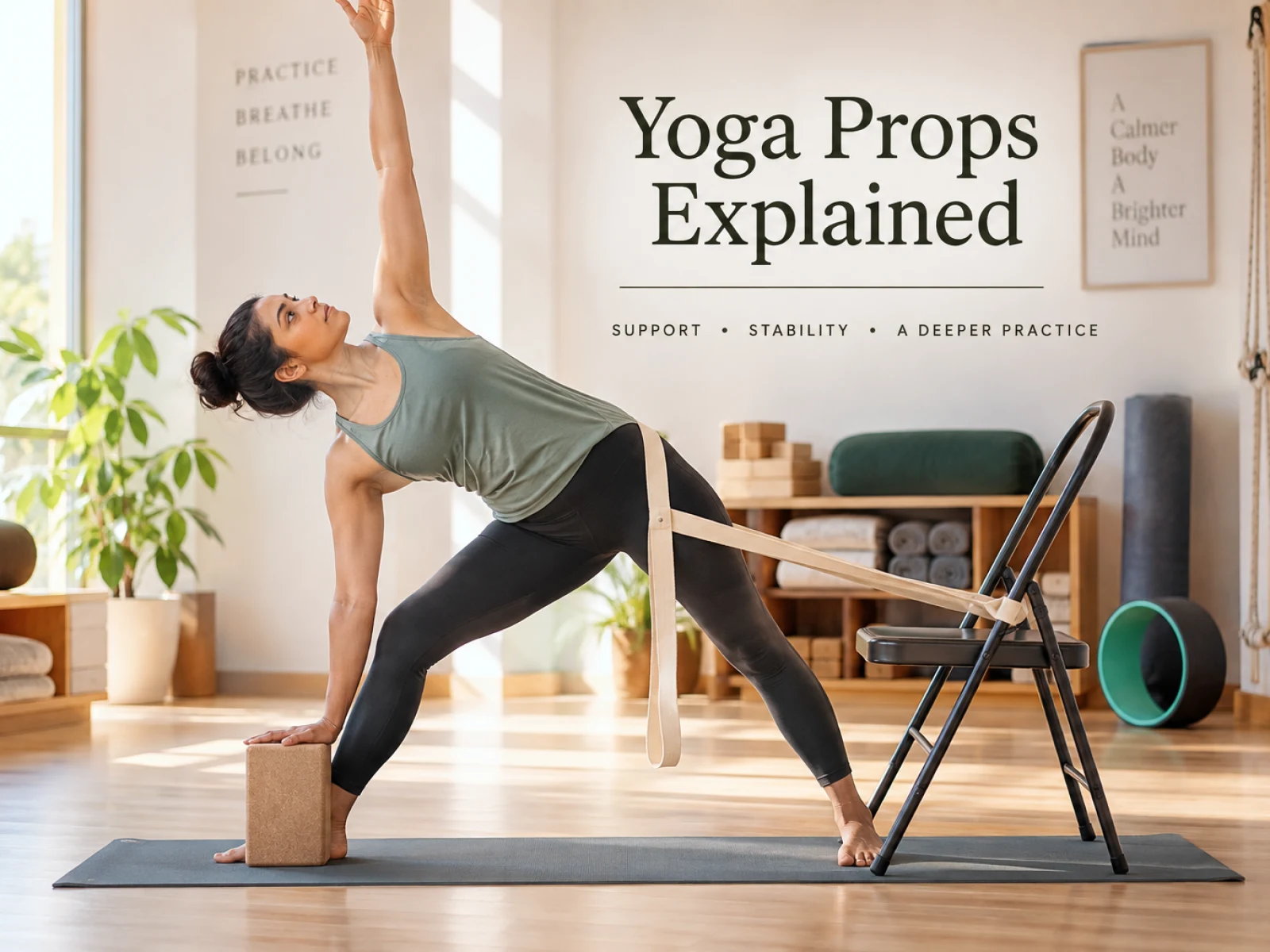
Yoga Props Explained: Blocks, Straps, Bolsters, Wheels, Chairs and Blankets: What Do You Actually Need?
Key Takeaways
- This article covers actionable guidance from Absolute Yoga's certified instructors.
- Topics include yoga practice, breathwork (pranayama), flexibility, mindfulness, and stress relief.
- Suitable for beginners and regular practitioners seeking structured yoga in Bangalore.
- Absolute Yoga offers in-studio, online, and aerial yoga classes from HRBR Layout, Kalyan Nagar.
When you attend your first yoga class in Bangalore, you will likely encounter a corner of the room stacked with blocks, rolled blankets, straps looped over hooks, bolsters, chairs, ropes and perhaps a yoga wheel. Without explanation, the whole setup can feel either unnecessary or intimidating.
Yoga props are not training wheels for beginners. They are precision tools that allow practitioners at every level to access poses more deeply, practise more safely, and explore the full range of a posture. This guide explains each major prop, who benefits from it, and how it is used.
The Intelligent Use of Props in Yoga
B.K.S. Iyengar, one of the most influential yoga teachers of the 20th century, is widely credited with popularising the use of props in modern yoga. His insight was simple: not every body can access every pose in its ideal form from the outset. Props can bridge the gap between where the body currently is and what the pose is intended to develop, without compromising alignment or forcing the body.
At Absolute Yoga in HRBR Layout, Kalyan Nagar, props are used thoughtfully across our in-studio yoga classes. Sahana, our classical and therapeutic yoga instructor, integrates props extensively to support alignment, recovery, and accessibility.
Common Yoga Props
Yoga Blocks
What they are: Rectangular blocks made from foam, cork, or wood. Standard dimensions are approximately 22cm x 15cm x 10cm, and they can be used at three different heights.
What they do: Blocks bring the floor closer to you. They reduce the distance a practitioner needs to reach, allowing proper alignment without forcing the body into compromise. They also add height in seated poses and support specific positions.
Common uses: Under the hands in Triangle Pose (Trikonasana) to maintain a long spine; under the hips in seated poses to support pelvic positioning; under the lower back in Supported Bridge Pose for restorative practice; and under the head in Supine Bound Angle Pose.
Who needs them: Everyone, at every level. Even advanced practitioners use blocks to refine alignment, explore variations, or support restorative practice.
Material guide: Foam blocks are lightweight and affordable, a good starting point. Cork blocks are firmer, more stable, and more durable. Wood blocks offer maximum stability but are heavy and less forgiving.
Yoga Straps (Belts)
- What they are: Woven cotton or nylon straps, typically 150â250cm in length, with a D-ring or buckle at one end.
- What they do: Straps extend your reach, allowing you to maintain proper alignment in poses where flexibility currently limits the full expression of a posture.
- Common uses: In Seated Forward Fold (Paschimottanasana) when you cannot reach your feet while keeping the spine long; in Reclining Hand-to-Big-Toe Pose to hold the leg without straining the hamstring; and in shoulder-opening poses to maintain appropriate arm spacing.
- Who needs them: Students with tight hamstrings, shoulder limitations, or those recovering from injury. They are also useful for advanced practitioners exploring precise alignment in deeper stretches.
Bolsters
- What they are: Firm, large cylindrical or rectangular cushions that are much denser than regular pillows.
- What they do: Bolsters provide passive support in restorative and yin poses. They allow the body to settle into a position with less muscular effort, supporting relaxation and longer holds.
- Common uses: Under the knees in Savasana to release the lower back; under the spine in Supported Fish Pose for chest opening; as support in Restorative Child's Pose; and as elevation in seated pranayama practice.
- Who needs them: Students practising restorative yoga, therapeutic yoga, yoga nidra, or those using yoga for stress relief. Sangeeta, our meditation and advanced practice specialist at Absolute Yoga, uses bolsters extensively in restorative sessions.
Yoga Wheels
- What they are: Circular wheels, typically 30â33cm in diameter, made from plastic or wood with a padded outer ring.
- What they do: Wheels can support backbending, spinal mobility and shoulder opening. They can also introduce balance and core-stability challenges.
- Common uses: In supported backbend variations for practitioners building spinal mobility; in Fish Pose for chest opening; and in selected core exercises requiring dynamic movement.
- Who needs them: Intermediate to advanced practitioners working on backbends and spinal mobility. They are less essential for beginners and those focusing mainly on therapeutic or restorative practice.
Yoga Chairs
- What they are: Stable, supportive yoga chairs designed to help practitioners modify, support or deepen postures.
- What they do: Chairs provide a dependable surface for support, alignment and leverage. They can make certain standing, seated, backbending and restorative postures more accessible while also helping experienced practitioners explore alignment in greater detail.
- Common uses: Supported backbends, seated poses, twists, leg and hip work, and selected inversions or therapeutic variations under teacher guidance.
- Who needs them: Beginners can use chairs for additional support, while experienced practitioners can use them to refine alignment and explore advanced variations. At Absolute Yoga, chairs are used extensively as part of our prop-based practice.
Yoga Blankets
- What they are: Firm, tightly woven Mexican or Iyengar-style blankets that are much denser and more supportive than regular household blankets.
- What they do: Blankets add height under the hips in seated poses, pad the knees and ankles in floor poses, provide warmth in Savasana, and can be folded into different shapes to substitute for or complement other props.
- Common uses: Under the hips in Dandasana (Staff Pose) to support correct pelvic positioning; padding under the knees in Vajrasana; and as a softer alternative to a block under the head in supported supine poses.
Yoga Ropes
- What they are: Fixed or wall-mounted ropes used as support and traction tools in selected yoga practices.
- What they do: Ropes can provide support, improve body awareness, assist alignment and make certain postures more accessible or more precise.
- How we use them: At Absolute Yoga, ropes are used alongside other props as part of structured practice, particularly when a teacher wants to explore alignment, mobility or supported variations.
The Wall: A Simple but Powerful Prop
- What it is: A humble wall is one of the most readily available yoga props, even though it may not look like one when you enter a studio.
- What it does: A wall can provide balance, stability, feedback and support. It can help beginners feel more secure while learning standing postures and can also be used by advanced practitioners for inversions, backbends, mobility work and alignment-focused variations.
- Why it matters: You do not always need specialist equipment to use a prop intelligently. Sometimes the most useful prop is already right in front of you.
Other Props Worth Knowing
- Eye pillows: Small, weighted bags placed over the eyes during Savasana or restorative poses to deepen relaxation and block light.
- Sandbags: Weighted bags placed on the body in restorative poses to encourage grounding and support longer, quieter holds.
- Yoga ropes: Useful for supported alignment, traction and selected advanced or therapeutic variations.
- Yoga chairs: Particularly valuable for supported inversions, backbends, seated work and alignment-focused practice.
Two Dedicated Props-Based Classes at Absolute Yoga
Props are not only something we bring into a regular class when needed. At Absolute Yoga, we also offer two dedicated props-based classes every week, each with a different purpose.
Props Asana
Props Asana is an advanced-level class where we use one to three props to understand alignment and work with longer holds. The use of props helps make advanced postures more accessible while giving practitioners the opportunity to work with greater precision. The practice also supports strength and tone in the muscles and joints through controlled, alignment-focused work.
Props Mobility
Props Mobility is a specific combination of dynamic movements and static holds curated by Trupti Rathi. Through more than 10 years of practice, Trupti observed how easily we fall into movement patterns such as relying more heavily on one side of the body or repeatedly using the same groups of muscles. Over time, these patterns can contribute to imbalance and injury.
Props Mobility uses props to target joints and core muscles in a focused way, helping practitioners build strength and mobility where they need it most. Rather than simply trying to become more flexible, the aim is to develop a more balanced and capable body.
Do You Need to Buy Props Before Your First Class?
No. When you join yoga classes in Bangalore at a studio like Absolute Yoga, all necessary props are provided in-studio. You will be shown how to use them by your teacher.
Once you establish a regular home practice, investing in a pair of blocks and a strap is worthwhile. Bolsters, chairs, ropes and wheels are more specialised items, so it makes sense to wait until your practice clearly calls for them.
For our live online yoga classes, having a pair of blocks and a strap at home can enhance the experience significantly. Our teachers also demonstrate modifications for those without props.
Experiencing Props in Practice
The best way to understand props is to use them in a structured class with an experienced teacher who can show you exactly how each prop modifies a pose for your body.
At Absolute Yoga in Kalyan Nagar, HRBR Layout, props are integrated naturally into practice. You will learn to use them intuitively rather than treating them as complicated pieces of equipment.
Book a trial class at absoluteyoga.in or WhatsApp us at +91 80955 10108. Morning batches start at 6:45 AM and evening batches at 6:00 PM, Monday to Friday.