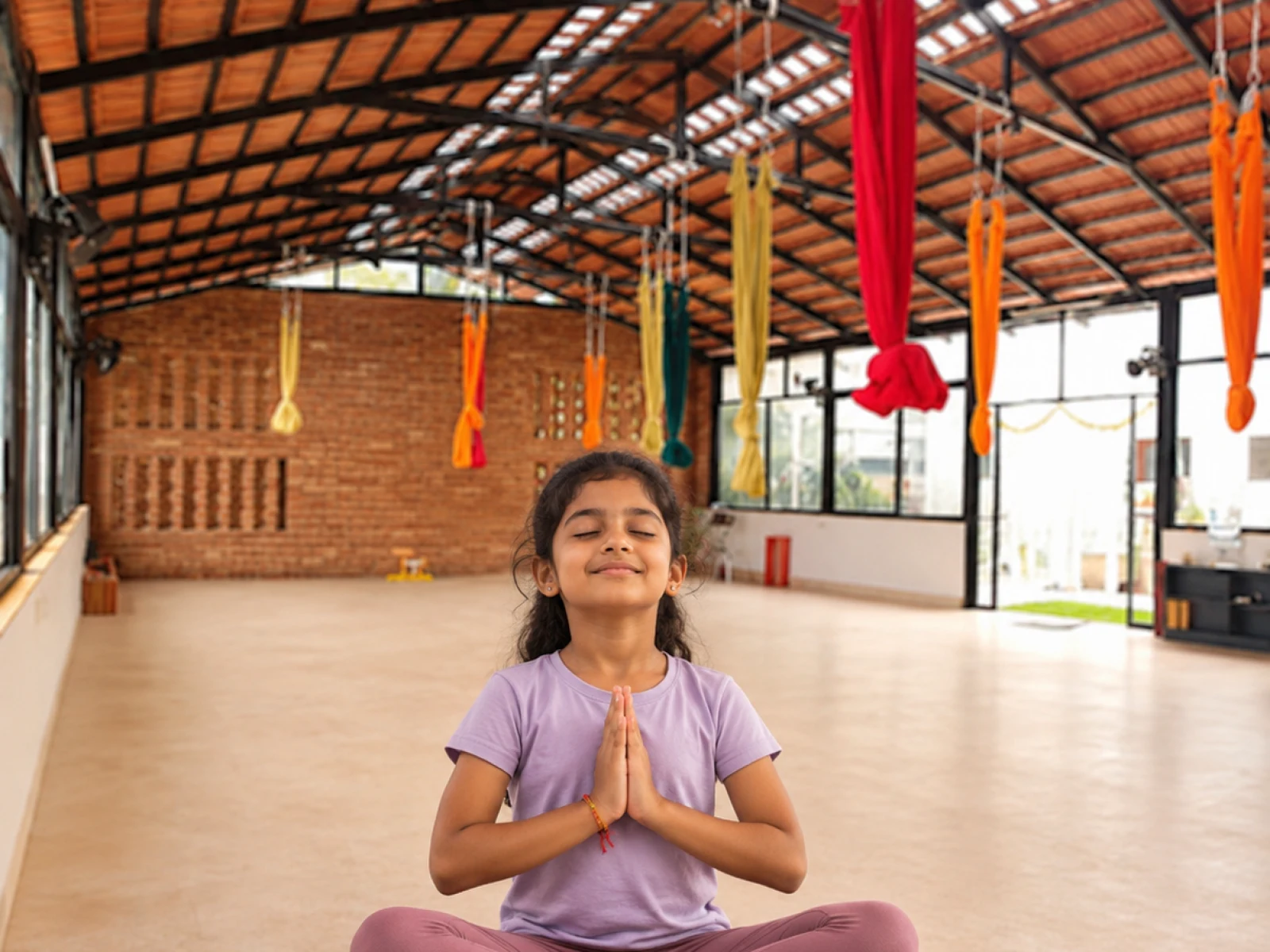
Kids’ Yoga: More Than Poses, A Space to Move, Play and Grow
Key Takeaways
- This article covers actionable guidance from Absolute Yoga's certified instructors.
- Topics include yoga practice, breathwork (pranayama), flexibility, mindfulness, and stress relief.
- Suitable for beginners and regular practitioners seeking structured yoga in Bangalore.
- Absolute Yoga offers in-studio, online, and aerial yoga classes from HRBR Layout, Kalyan Nagar.
What if yoga felt less like a class and more like an adventure?
Imagine a child stretching their arms like a tree, balancing like a flamingo, curling up like a sleeping hedgehog and making a gentle buzzing sound like a bee. They are moving, breathing, imagining and discovering what their bodies can do. Nobody is asking them to touch their toes or hold a perfect pose. That is a much better starting picture of childrenâs yoga.
Parents often search online for yoga classes near me because they want an activity that offers more than another hour in front of a screen. They may be hoping their child becomes more active, learns to settle after a busy day or gains confidence trying something new. Yoga can create opportunities for movement, body awareness and simple mindfulness. It should not be sold as a cure for restlessness, anxiety, attention difficulties or any medical condition. It is a practice, not a magic fix. If you are looking for yoga classes near me for a child, check that the provider runs a child-specific session.
The most important thing to understand is that children are not miniature adults. A good kids yoga session should respect their age, attention span, energy, curiosity and need to play. If you are comparing yoga classes near me for your child, look beyond the photographs of children in impressive poses. Ask what actually happens during the session and how the teacher keeps it safe, enjoyable and age-appropriate.
What is kids yoga, really?
Kids yoga brings together simple movement, age-appropriate postures, breathing awareness, relaxation and mindfulness activities. The format may include animal movements, stories, songs, games, balance challenges and quiet moments. The aim is not to make children perform advanced asanas. It is to introduce movement and awareness in a way they can understand and enjoy.
Action for Healthy Kids describes yoga as a combination of breathing techniques, yoga poses and mindfulness, and notes that it can be adapted for different ages, goals and ability levels. Its resource also suggests beginning with short sessions of around three to five minutes in a classroom setting, then building gradually as children become comfortable. That is a useful reminder for parents: engagement matters more than duration. Read its practical resource on yoga and mindfulness for children.
When families search for yoga classes near me, they may find adult studios that simply invite children into a regular class. That is not automatically a childrenâs programme. The teacher needs to adapt the language, sequence, pace and expectations. A child-friendly session should feel structured without becoming rigid, and playful without becoming chaotic. A search for yoga classes near me should lead to questions about age suitability, not just distance.
Why might yoga be useful for children?
1. Body awareness and coordination. Balancing, reaching, bending gently and changing positions can help children notice how their bodies move. A tree pose becomes a balance game; a cat-cow movement becomes a chance to explore the spine through a simple story. These activities are not a competition and children should never be pushed into a range of movement.
2. A vocabulary for feelings. A child may not always know how to explain feeling wound up, disappointed or tired. A short pause to notice the breath or name how the body feels can introduce a simple way to check in. This does not mean yoga will resolve difficult emotions. It gives children a low-pressure opportunity to practise noticing them.
3. Confidence without comparison. In a thoughtfully led session, children can discover that balance looks different for everyone. One child may hold a pose for a few seconds; another may need a wall or a seated variation. Both can participate successfully. This is one of the strongest reasons parents may consider yoga classes near me that are designed specifically for children rather than adapted from an adult timetable.
4. Listening, turn-taking and cooperation. Partner activities and group games can give children opportunities to wait, take turns, follow simple instructions and work with others. The teacher should keep these activities inclusive. A child who does not want to take part in a partner pose should be offered another option without embarrassment.
5. A calmer transition in the day. A short breathing or relaxation activity may help some children shift from a high-energy activity to a quieter one. Keep expectations realistic: children will still be children. They may giggle, wriggle, ask questions or need a movement break. A successful class is not one in which every child sits silently.
A childâs yoga class should not look like an adult class
An adult may be happy to spend a long time repeating a sequence or holding a posture. Many children learn better when activities change and the teacher uses images, stories and play. Kat Heagberg Rebarâs Yoga International article describes how games, songs, stories and partner activities can help keep children engaged, and emphasises that children are not simply smaller adults. The article is a helpful teaching perspective, not a clinical trial. Explore the secret to teaching yoga to children.
A session might begin with a welcome circle and a simple movement game. Children could then explore a few poses through a story, practise a gentle breathing activity and finish with a short rest or guided imagination exercise. The order and length should change according to the age group and the children in the room. If a class is built around a strict adult-style sequence, ask why.
Safety: what parents should expect
Safety should be built into the design of the session, not added as a disclaimer at the end. The Morarji Desai National Institute of Yogaâs protocol for children aged three to six gives age-specific guidance: keep the session within the recommended duration, use gentle movements and games, demonstrate poses, avoid prolonged holds and breath retention, and do not push children into extreme movements. It also emphasises supervision by a trained yoga teacher and attention to any discomfort.
The protocol is guidance for a particular age group, not a universal prescription for every child. A class for a four-year-old should not be planned in the same way as a session for a ten-year-old. Parents should tell the instructor about relevant injuries, health conditions, recent surgery, dizziness, breathing concerns or movement restrictions before the child participates. If a child reports pain, feels unwell or does not want to continue, the activity should stop and the concern should be taken seriously.
How do you know whether a class is genuinely child-friendly?
If you are searching for yoga classes near me, use the first conversation with the studio to understand the programme. Ask these questions: Families searching for yoga classes near me should ask about instructor experience with children.
- What age range is the class designed for? A group of preschoolers has different needs from a group of pre-teens.
- How many children are in each session, and how many adults supervise? Ask how the teacher manages a full class.
- What does a typical session include? Look for a balance of movement, play, simple breathing and rest, rather than a long sequence of demanding poses.
- How are children with different confidence levels included? There should be no pressure to perform or compete.
- What training and experience does the instructor have in teaching children? Adult yoga teaching experience alone does not automatically mean someone knows how to teach children.
- What is the policy if a child feels uncomfortable or wants to sit out? Children should be listened to.
What can a playful kids yoga session include?
A simple session can use a theme. In a garden adventure, children might grow tall like trees, stretch like flowers opening, move slowly like a snail and balance like a butterfly. In an animal journey, they might explore cat, cow, frog or cobra-inspired movements with comfortable ranges and plenty of space. A story gives the movement a purpose, while games help children practise listening and taking turns.
Breathing activities should be gentle and easy to understand. Children might notice the movement of their belly while resting a hand on it, or imagine smelling a flower and slowly cooling soup. Avoid forceful breathing, long breath holds or making a child feel they must control their breathing perfectly. Relaxation can be brief: lying down, sitting comfortably or imagining a quiet place for a few moments.
At what age can children start yoga?
There is no single age that suits every child or every format. Younger children generally need shorter, more playful activities and close supervision. Older children may be ready for a little more structure, longer sequences or a conversation about breath and body awareness. Readiness depends on the childâs development, interest, comfort and the teacherâs ability to adapt.
The Government of Indiaâs Morarji Desai National Institute of Yoga has published a protocol specifically for children aged three to six. It includes gentle joint movements, child-friendly names for actions, postures, breathing and games. Treat it as an age-specific reference for trained facilitators, not a home routine to copy without understanding the childâs needs.
How parents can support the experience at home
Keep the tone light. A child may enjoy one session and be less interested the next week. That is normal. Instead of asking whether they were the best in class, ask what made them laugh, which movement felt interesting or whether there was a moment they liked being still. These questions reinforce curiosity rather than performance.
Finding the right kids yoga option near you
A local search for yoga classes near me can return general yoga studios, fitness centres, online videos and programmes designed specifically for children. Check that the class actually accepts the childâs age group. Confirm the instructor, session duration, group size, location, supervision and whether a parent can observe or discuss the first session. Do not assume that an adult beginner class is suitable for a child. A local search for yoga classes near me is only the first step; verify the programme details directly.
For families around Kalyan Nagar, HRBR Layout, Kammanahalli and Banaswadi, Absolute Yoga is a local yoga studio with in-studio, online and other yoga offerings. You can explore the Absolute Yoga homepage for the studio overview, the in-studio class information for current adult class details, and the About Absolute Yoga page to learn about the teaching team and Trupti Rathiâs approach. The Absolute Yoga blog offers further reading on yoga and mindful practice.
Important: this article is an educational guide, not an announcement that Absolute Yoga currently runs dedicated childrenâs yoga batches. Parents searching for yoga classes near me for children should contact the studio first and ask whether a child-specific programme is available, what ages it would serve and who would teach it. A programme should only be promoted once its format, teacher preparation, safety procedures and timetable are confirmed. For adults checking existing studio options, the general booking page is available, but it is not a dedicated kids-class booking link.
A note from Trupti Rathi, Founder of Absolute Yoga
âFor children, yoga should begin with curiosity, not correction. I would want them to feel that they can explore movement, ask questions and enjoy the process without worrying about getting a pose perfect.â
Suggested founder quote for approval before publication. This is proposed editorial wording, not a verified verbatim statement from Trupti Rathi.
âThe aim is not to make children sit still for an hour. It is to give them a positive experience of movement, awareness and rest that respects who they are at that age.â
The best measure of a childrenâs yoga class
A good class is not measured by how straight a childâs legs look, how long they balance or how quietly they sit. Look instead for a child who feels welcome, has been allowed to participate at their own pace and leaves with a positive experience of movement. Some days that may mean trying a new pose. Other days it may mean joining a game, resting when needed or simply feeling comfortable in the room. Parents comparing yoga classes near me should look for a welcoming, supervised and age-appropriate experience.
So, when you type yoga classes near me into a search box, remember that the nearest class is not automatically the right one. Look for a programme designed for children, a teacher who understands their developmental needs and a setting where safety and enjoyment come before performance. That is where a meaningful relationship with movement can begin. If you are still comparing yoga classes near me, prioritise safety and age-appropriate teaching. A thoughtful choice among yoga classes near me starts with the childâs comfort and the teacherâs preparation.
Frequently asked questions
Is yoga suitable for every child?
Many children can participate in appropriately adapted yoga, but the format should reflect the childâs age, health, development and comfort. Discuss relevant medical or mobility concerns with a healthcare professional and the instructor first.
How long should a kids yoga class be?
There is no single duration for all ages. Official protocols give age-specific recommendations. Younger children generally need shorter, varied sessions with movement and play rather than prolonged posture holds.
Can yoga help children with focus?
Some educational resources describe potential benefits for attention, body awareness and readiness to learn. These should be treated as possible supportive outcomes, not guaranteed results or treatment for attention-related conditions.
Should children practise pranayama?
Only simple, gentle, age-appropriate breathing awareness under suitable guidance. Avoid forceful breathing and breath retention unless a qualified professional has specifically assessed the practice and its suitability.
What should I look for when searching for yoga classes near me for my child?
Check the age group, teacherâs experience with children, session design, group size, supervision, safety practices and whether children can opt out of an activity.
Can my child join an adult yoga class?
Do not assume so. Adult classes may use longer sequences, different language and expectations that are not appropriate for children. Ask the studio whether it has a specifically designed childrenâs programme.
Does Absolute Yoga currently offer kids yoga classes?
This article does not announce a current kids yoga programme. Contact Absolute Yoga directly to confirm whether a child-specific class is available or being planned.